Method
Gas Chromatograph:
Kristall 2000M or Chromatec-Kristall 5000/9000
Detector: Flame Ionization Detector (FID)
Column:
HP-1-type capillary column (DB-1 or BP-1), 100 m × 0.25 mm × 0.5 µm
Sample Inlet:
Automatic valve with splitter for column backflushing
Additional Equipment:
Sampling Devices:
Method Description
This method determines light hydrocarbons up to and including nonane in stabilized crude oil. Its results can be combined with those obtained using ASTM D7169 and IP 545 to produce a complete crude-oil boiling-point distribution.
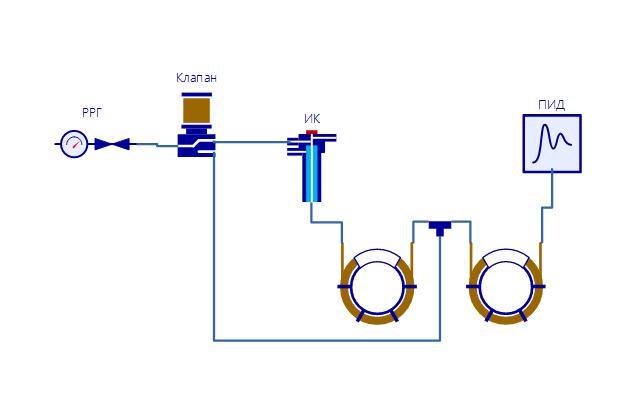
The instrument is a modified Detailed Hydrocarbon Analysis (DHA) chromatograph. The main difference is its backflushing capability, which protects the column from components heavier than nonane. The system uses a three-way valve and a SilFlow splitter to perform backflushing.
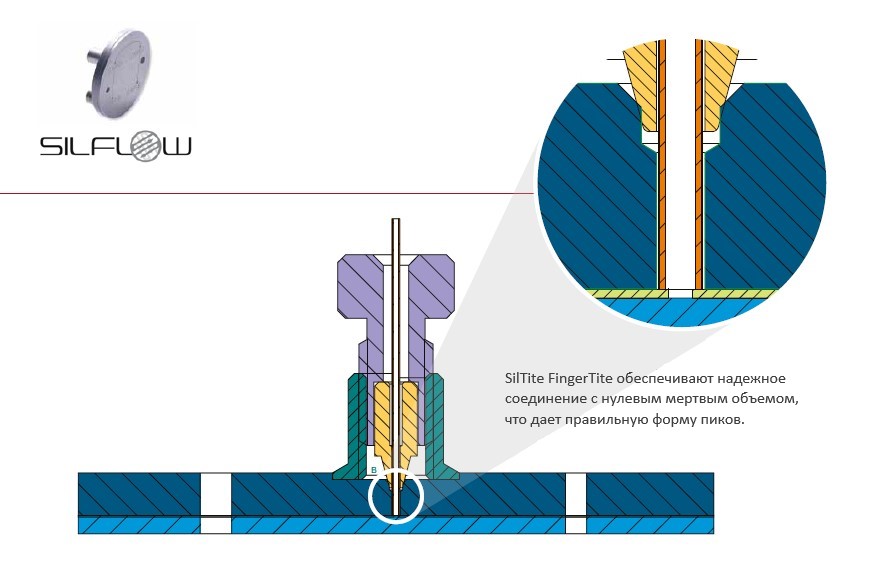
The SilFlow splitter features highly inert internal channels and no dead volume. As a result, chromatograms obtained with the splitter installed are equivalent to those obtained without it.
SilFlow Splitter
Quantitative analysis is performed using the internal-standard method. 1-Hexene or 3,3-dimethyl-1-butene is recommended as the internal standard. Compounds are identified using relative retention indices, similarly to the DHA method.
Chromatec-Kristall 5000 Gas Flow Diagram for ASTM D7900
ASTM D7900 — Standard Test Method for Determination of Light Hydrocarbons in Stabilized Crude Oils by Gas Chromatography