Method
Chromatographic system based on:
Kristall 2000M or Chromatec-Crystal 5000/9000
Detectors:
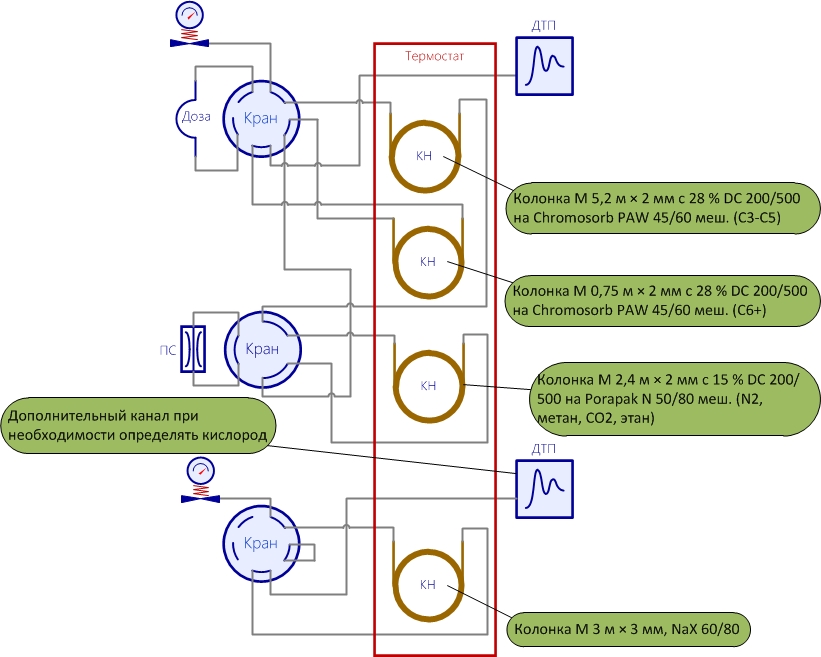
TCD; if oxygen analysis is required, two detectors will be needed
Packed columns:
M 0.75 m × 2 mm with 28% DC 200/500 on Chromosorb PAW, 45/60 mesh
M 5.2 m × 2 mm with 28% DC 200/500 on Chromosorb PAW, 45/60 mesh
M 2.4 m × 2 mm with 15% DC 200/500 on Porapak N, 50/80 mesh (column length may be increased for better component separation)
M 3 m × 3 mm, NaX 60/80 (additional column if oxygen determination is required)
Injection system:
Chromatec or Valco 6-port and 10-port valves with 1 mL sample loop volume
Heated transfer line
Gas flow indicator
Additional data processing software:
Chromatec Gas
Additional equipment:
Gas fittings kit 4.078.000
Certified gas mixtures (PGS, IPG) for instrument calibration
Adjustable pneumatic resistance RPS 5.150.019 for operation with standard gas mixtures and sampling devices
Method Description
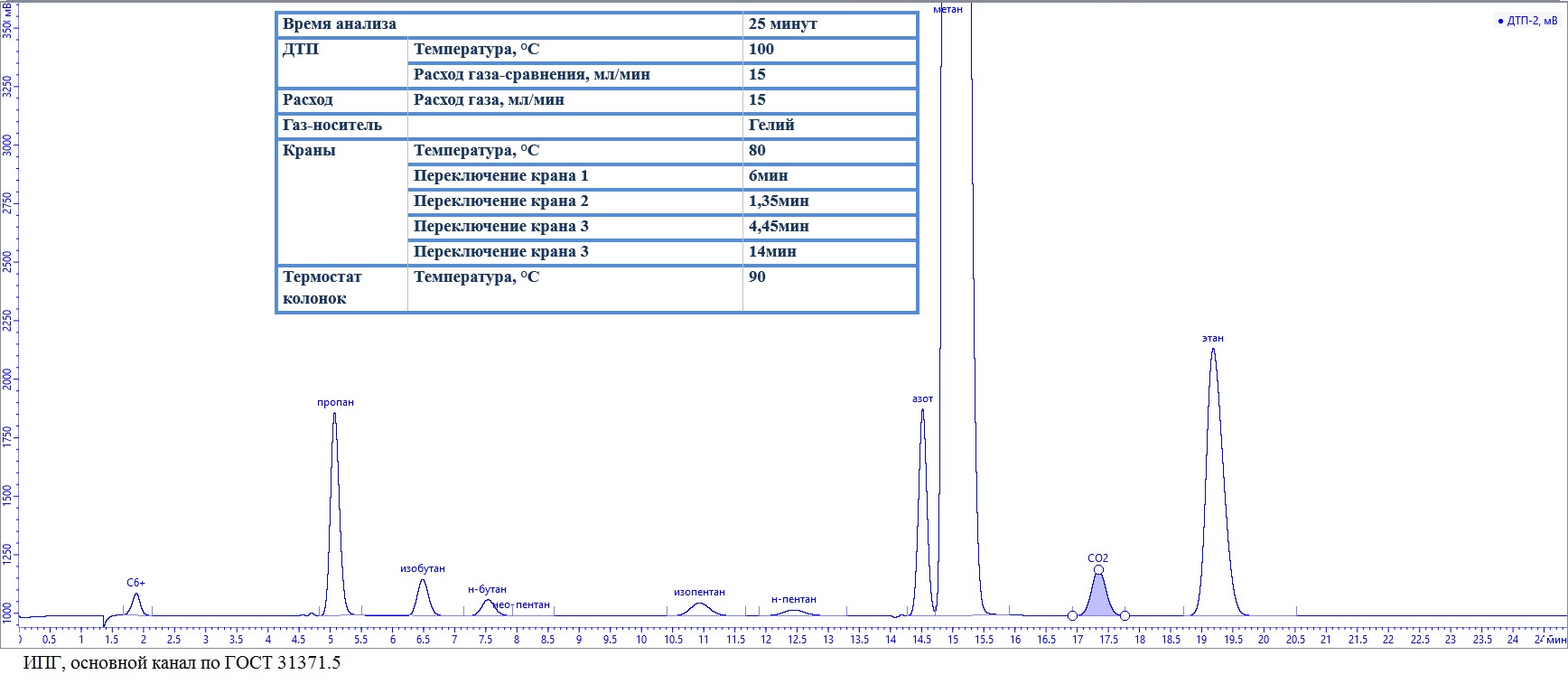
GOST 31371.5-2008. Natural gas. Determination of composition by gas chromatography with uncertainty evaluation. Part 5. Determination of nitrogen, carbon dioxide, C1-C5 hydrocarbons, and C6+ hydrocarbons in the laboratory and during continuous monitoring using three columns.
This method applies to the determination of the molar fractions of natural gas components within the ranges given below, provided that the gas does not contain hydrocarbon condensate and/or water.
Hydrocarbons heavier than n-pentane are treated as a C6+ pseudocomponent, which is measured as a single composite peak and calibrated accordingly. The actual composition of the C6+ fraction is determined either by extended analysis of individual C6 and heavier hydrocarbons or based on statistical data.
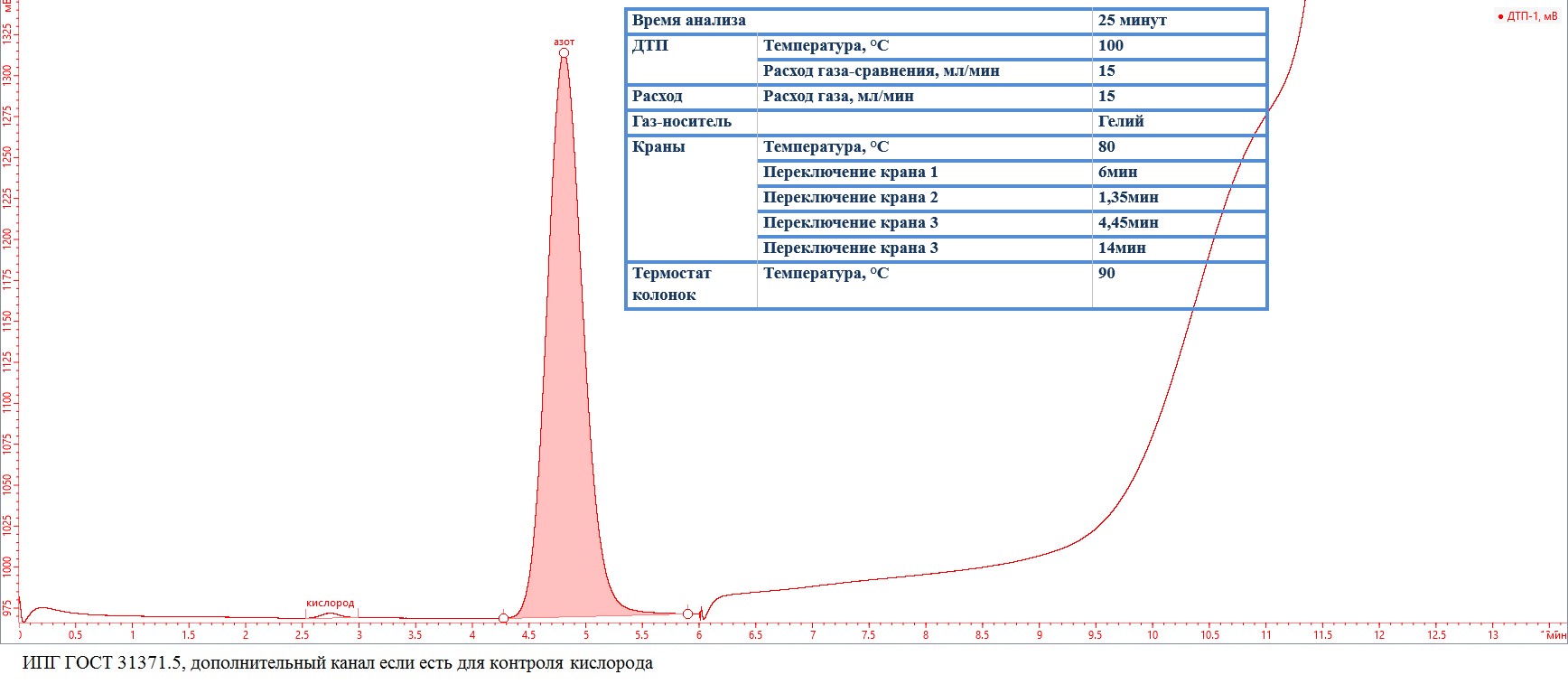
Natural gas normally does not contain oxygen, and oxygen is therefore absent from the gas sample. If oxygen is present as a result of air contamination of the sample, it will be measured together with nitrogen. Determining the combined molar fraction (oxygen + nitrogen) instead of measuring these components separately introduces only a minor contribution to the overall measurement error, due to the small difference between detector responses to oxygen and nitrogen.
Nevertheless, the result for a natural gas/air mixture remains sufficiently accurate, since neither component contributes to the calorific value. However, when oxygen analysis is required in practice, an additional channel with an extra valve, a NaX column, and a separate TCD is often used.
A key feature of this method is analysis under isothermal operating conditions. For this reason, this part of the standard is often used for process chromatographs (Chromatec-Crystal 7000) and portable chromatographs (Gazokhrom 2000).
GOST 31371.5
Molar fraction ranges of components covered by GOST 31371.5
| Component | Formula | Molar Fraction, % |
|---|---|---|
| Nitrogen | N2 | 0.001–15 |
| Methane | CH4 | 75–100 |
| Carbon Dioxide | CO2 | 0.001–8.5 |
| Ethane | C2H6 | 0.001–10 |
| Propane | C3H8 | 0.001–3 |
| Isobutane | C4H10 | 0.001–1 |
| n-Butane | C4H10 | 0.001–1 |
| Neopentane | C5H12 | 0.001–0.5 |
| Isopentane | C5H12 | 0.001–0.5 |
| n-Pentane | C5H12 | 0.001–0.5 |
| Hexanes + total C6 and heavier hydrocarbons | — | 0.001–1 |